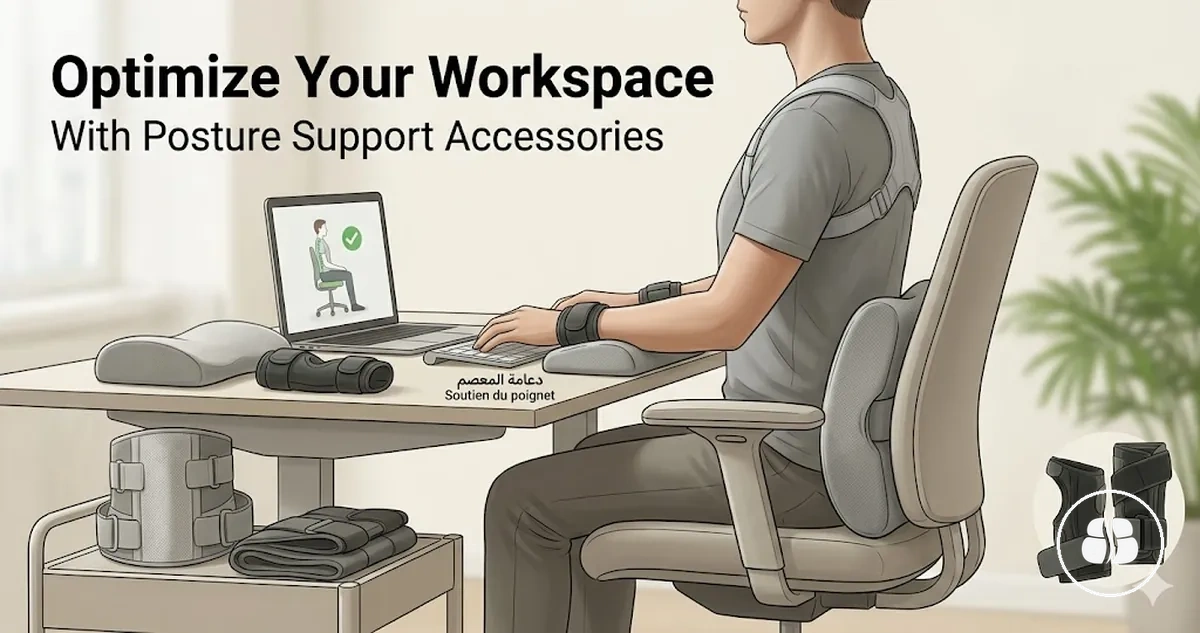
Workspace posture support accessories for ergonomic desk setup
Posture support accessories are support tools used inside an ergonomic desk setup to help a seated workspace fit the user, not to guarantee posture correction by themselves. Their usefulness depends on how the accessory works with chair fit, desk height, monitor position, keyboard reach, foot support, and the daily work routine around it. The main issue is workspace compatibility.
Chair shape can change where lumbar support or a seat cushion makes contact, while desk height can affect arm position and torso lean. Monitor position, keyboard reach, and mouse reach may also pull the user forward when the desk workspace is not adjusted around the support. Foot support can influence seated balance, so compatibility evaluation should look at the workstation before judging the accessory alone.
Posture support can provide contact, cueing, or back support, but workstation adjustment still controls many desk posture conditions. A shoulder support, for example, may remind a user not to round forward, but if the keyboard is too far away for that body size and chair position, forward lean may continue. This is the boundary between accessory support and ergonomic fixes.
Selection should start with the local fit problem: lower-back contact, seat pressure, shoulder cueing, or seated stability. Adjustment should then test support placement, chair height, desk height, monitor position, keyboard reach, and foot contact without turning the page into a product catalogue. Later practical use checks can separate a support-format mismatch from a workstation mismatch.
Safe use also depends on pressure, discomfort, breaks, and adjustment tolerance during desk work. If a support creates numbness, worsening discomfort, or pressure that does not settle after repositioning, stop using it and reassess the fit conditions before continuing.
How posture support accessories work inside a desk workspace
Posture support accessories are support and cueing tools that interact with the body through specific contact points inside a desk workspace. Their role is to provide support, awareness, or positioning cues during seated work rather than act as a complete workstation solution. How posture support accessories work inside a desk workspace depends on the surrounding desk setup.
How posture support accessories work inside a desk workspace becomes easier to understand when the relationship between the accessory and the user is visible. The diagram below clarifies accessory type, contact point, posture cue, and workstation dependency within a seated workspace.
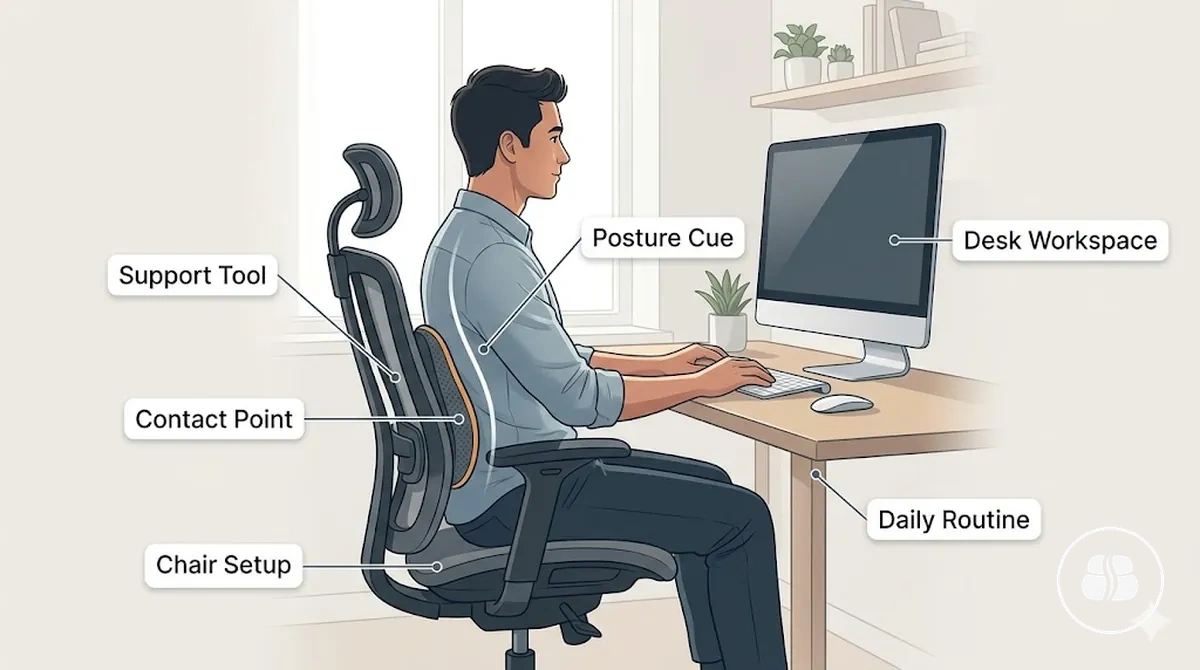
A support accessory typically works through a contact point such as the lower back, seat surface, or upper torso. That contact point can create a posture cue that encourages awareness of sitting position during a daily routine. Unlike complete workstation correction, posture support accessories provide localized support and feedback. Comfort signals and usefulness may vary with support position, sitting duration, and workstation dependency.
A lumbar support may provide a different posture cue on two chair setups even when the accessory remains unchanged, because chair shape can influence how the contact point interacts with the user. The same support may also feel different across desk workspace arrangements when sitting duration or daily routine changes. For a broader view of related accessory types and workspace applications, see the Posture support accessories hub.
What posture support can and cannot fix in workstation ergonomics
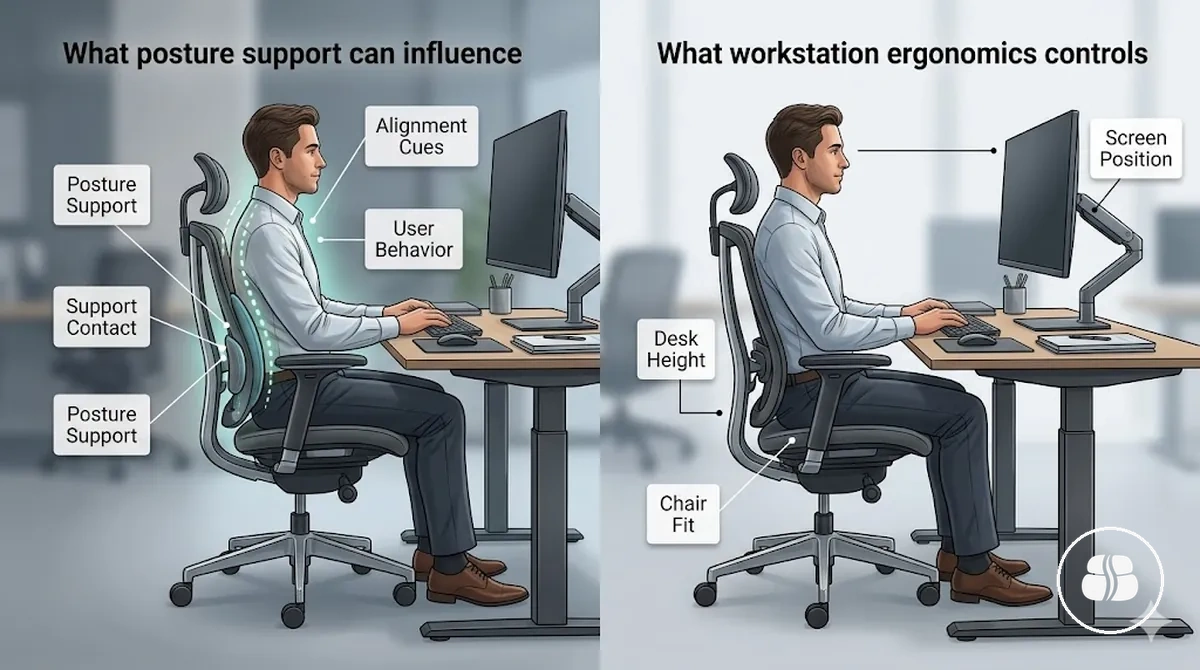
Posture support can influence alignment cues and support contact, while workstation ergonomics still depends on factors that accessories cannot fully replace. The distinction matters because desk height, screen position, chair fit, and user behavior may continue to affect outcomes even when posture support is present. Any improvement remains a conditional outcome that depends on the surrounding setup.
What posture support can and cannot fix in workstation ergonomics becomes easier to understand when support effects are separated from workstation constraints. The illustration below clarifies which changes may come from posture support and which conditions still depend on the workspace arrangement.
| Posture support may help with | Workstation setup still controls |
|---|---|
| Providing alignment cues when support contact matches the user and chair fit | Desk height when arm position remains mismatched |
| Increasing awareness of sitting position during a work session | Screen position when viewing angle continues to encourage leaning |
| Supporting a more consistent posture cue under suitable conditions | Chair fit when the chair shape or adjustment range remains unsuitable |
| Encouraging attention to sitting habits and user behavior | Workspace constraints that require workstation adjustment |
A lumbar support may improve alignment cues when support contact suits the chair fit, yet posture strain can remain if screen position or desk height continues to create an awkward working posture. This contrast does not mean posture support is ineffective or that workstation adjustment alone solves every issue; the result depends on how posture support, workstation ergonomics, and user behavior interact over time.
Workspace factors that affect posture support compatibility
Workspace factors determine posture support compatibility because accessories interact with linked workstation variables rather than a single chair feature. A support that seems ineffective may be affected by chair dimensions, backrest shape, seat depth, desk height, monitor height, keyboard reach, mouse reach, foot support, or accessory stability instead of the accessory itself. Compatibility should be judged through linked workspace conditions before judging the accessory.
Workspace factors that affect posture support compatibility become easier to evaluate when the relationship between the accessory and the workstation is visible. The diagram below clarifies which labels verify fit conditions, support placement, and setup factors that may influence support function.
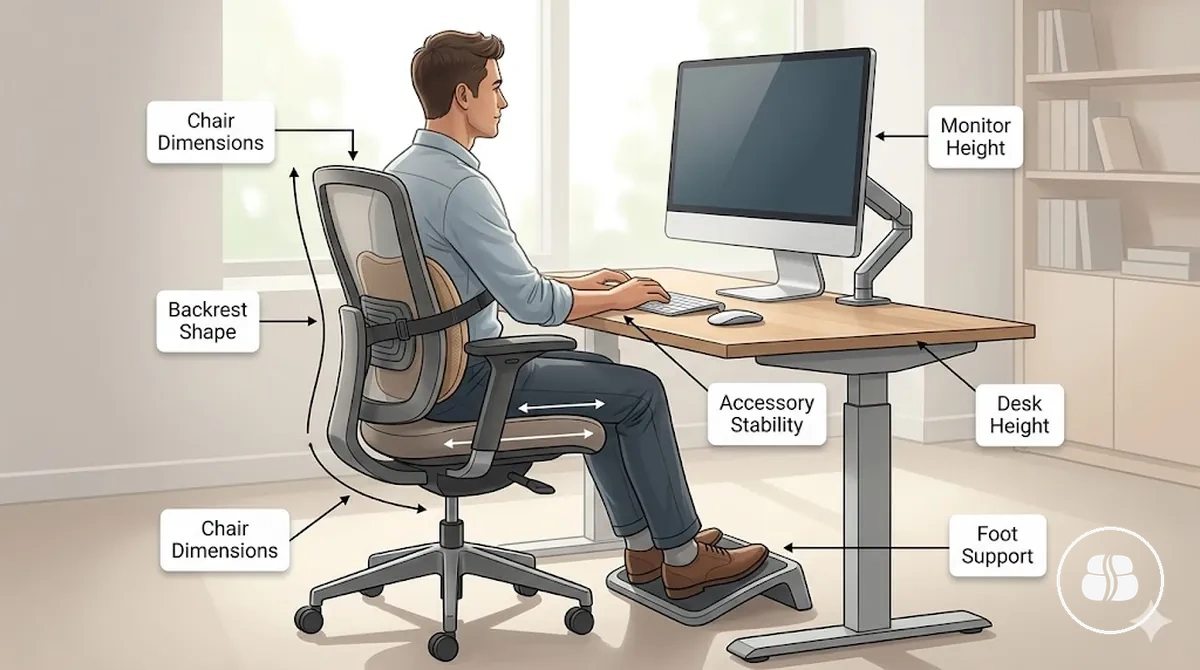
Chair dimensions, backrest shape, seat depth, desk height, monitor height, keyboard reach, mouse reach, foot support, and accessory stability form connected attribute groups. A change in one factor may influence another, such as seat depth affecting pelvic position or monitor height influencing forward lean. Because these workstation variables interact, posture support compatibility depends on overall fit conditions rather than a single adjustment.
| Workspace factor | Attribute to check | Condition to look for | Effect on support fit |
|---|---|---|---|
| Chair dimensions | Support placement | Support aligns with the seated contact area | May improve stability and contact consistency |
| Backrest shape | Surface contour | Support follows the chair profile | May reduce shifting or uneven contact |
| Seat depth | Pelvic position | Seated posture remains balanced | May help support stay in the intended position |
| Desk height | Elbow angle | Working posture does not encourage excessive leaning | May improve perceived support effectiveness |
| Monitor height | Viewing distance | Head and torso remain closer to a neutral posture | May reduce forward lean |
| Keyboard reach and mouse reach | Input distance | Frequent reaching is limited | May reduce movement away from the support contact area |
| Foot support | Lower-body support | Feet remain adequately supported | May assist seated stability |
| Accessory stability | Support retention | Accessory remains positioned during use | May improve consistency of support contact |
If a workspace factor appears mismatched, adjusting that condition may be more useful than judging the accessory immediately because the observed outcome can reflect the setup rather than the support itself. For chair-related evaluation criteria and fit considerations, see Posture support accessories for office chairs.
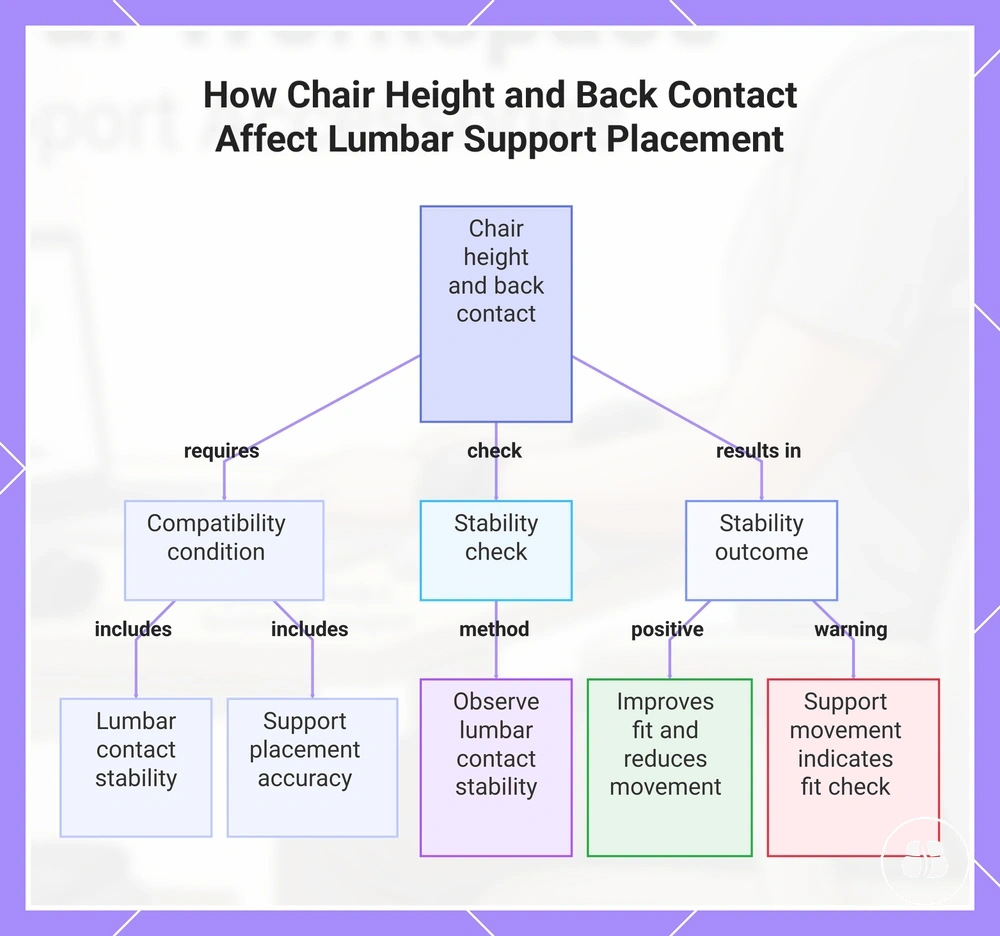
Chair height and back support contact
Chair height and back support contact determine whether support placement reaches the intended lumbar contact area. Backrest contour and seat depth influence where a posture support accessory meets the body and how stable that contact remains during use. The local compatibility condition depends on consistent lumbar contact and support placement.
Chair height and back support contact can be checked by observing whether lumbar contact remains stable when sitting normally against the backrest contour. If chair height or backrest angle changes the seated position, the contact point may shift higher or lower than intended. A support that moves during use can indicate a fit check involving seat depth, support placement, or accessory movement rather than the accessory alone. Under suitable setup conditions, stable support contact may improve support fit and reduce unwanted movement.
This chart explains how chair height and back support contact determine lumbar support placement, the check for stability, and the outcomes of stable or unstable contact.
Desk height and seated body alignment
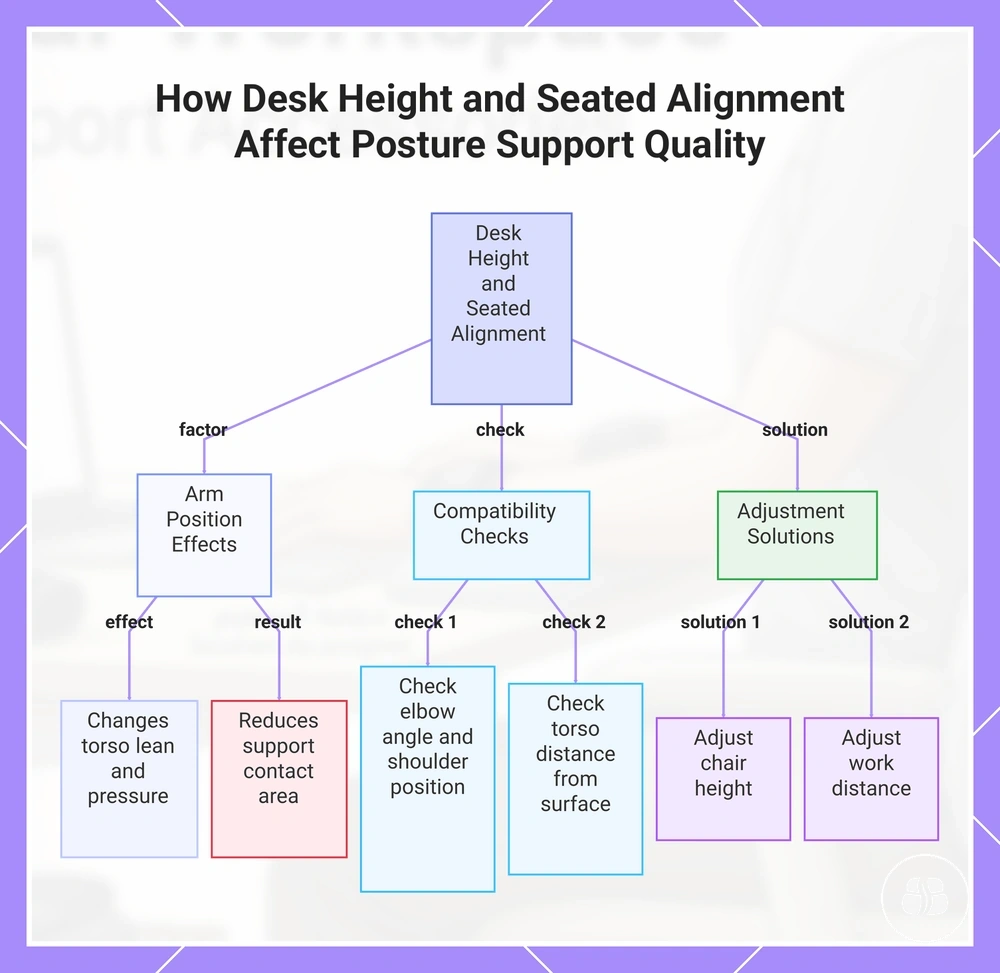
Desk height and seated body alignment affect how useful posture support feels during desk work because arm position can change torso lean and support pressure. If desk height pushes the elbows too high, too low, or too far from the body, the user may move away from the support contact area. The local compatibility condition depends on whether the seated position lets support pressure remain steady without forcing reach or shoulder tension.
Desk height and seated body alignment can be checked through elbow angle, shoulder position, and torso distance from the work surface. Different body sizes, chair heights, and fixed-desk constraints may change whether the same support placement feels stable or pressured. If the desk position causes leaning before the accessory is judged, adjusting chair height or work distance may improve support fit under suitable setup conditions.
This chart shows how desk height and body alignment influence posture support, including effects of arm position, compatibility checks, and adjustment solutions.
Monitor, keyboard, mouse, and arm position
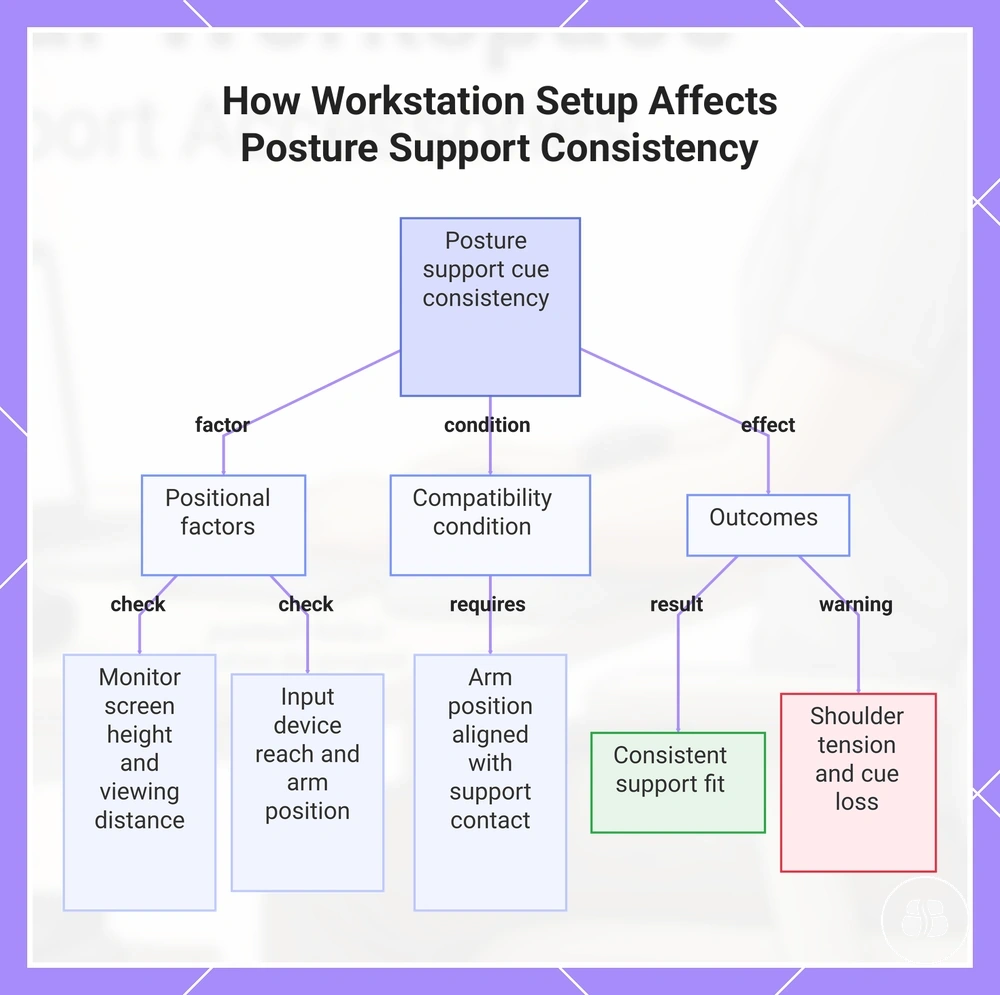
Monitor position, keyboard reach, mouse reach, and arm position influence whether posture cues from a support accessory remain consistent during desk work. Screen height, viewing distance, and reach demands can pull the user toward or away from support contact and may affect shoulder tension or upper-back posture response. The local compatibility condition depends on whether arm position allows the seated position to stay connected to the intended support area.
Monitor, keyboard, mouse, and arm position can be checked through screen height, viewing distance, keyboard reach, mouse reach, and wrist and forearm support. A support may be placed correctly, yet forward reach toward input devices can still move the torso away from the support contact area. If monitor position or reach requirements create repeated forward reach, shoulder tension may increase and posture cues may become less noticeable. Under suitable setup conditions, reduced reach demands may help maintain more consistent support fit.
This chart shows how monitor, keyboard, mouse, and arm positions influence posture cue consistency and the conditions for maintaining support contact.
Foot support and lower-body positioning
Foot support and lower-body positioning affect seated stability because lower-body stability influences how consistently a posture support accessory maintains support contact during desk work. Floor contact, knee angle, pelvic tilt, and pressure distribution can change the seated position and alter support stability over time. The local compatibility condition depends on whether lower-body positioning supports stable support contact without creating uneven pressure distribution.
Foot support and lower-body positioning can be checked through floor contact, knee angle, pelvic tilt, and pressure distribution during normal use. If chair height limits consistent floor contact, a footrest may be needed for some users to maintain a more stable seated position. Changes in chair height or user height can also influence accessory stability by changing pelvic tilt and pressure distribution. Under suitable setup conditions, improved lower-body stability may help maintain more consistent support fit.
Matching posture support accessories to desk-work needs
Matching posture support accessories to desk-work needs depends on the specific fit need and the workstation constraint affecting desk work. Different support types address different local positioning or support-contact conditions rather than the same issue. The selection decision should start by identifying desk-work needs.
Lumbar support, seat cushion, wedge, shoulder support, and upper-back support serve different support functions. Lumbar support is associated with lower-back positioning and chair fit, while a seat cushion or wedge relates more closely to pelvis support and seated pressure distribution. Shoulder support and upper-back support focus on upper-body posture cues during a desk routine. Comfort tolerance, use duration, and workstation constraint can influence whether a support format remains suitable over time.
The comparison below organizes support types by fit need, compatibility condition, and decision signal. It is intended to separate a support-fit need from a habit, keyboard reach pattern, or workstation-adjustment need before choosing a support type.
| Desk-work need | Accessory type to consider | Compatibility condition | Decision signal |
|---|---|---|---|
| Lower-back positioning concern | Lumbar support | Chair fit allows stable support contact | Support contact changes with backrest positioning |
| Seated pressure or pelvis support concern | Seat cushion | Seat surface and desk height remain compatible | Comfort signals are linked to seated contact areas |
| Pelvic positioning adjustment | Wedge | Seated posture remains stable during use | Positioning changes are related to sitting angle |
| Slouching cue during desk work | Shoulder support | Keyboard reach and desk routine do not create repeated forward reach | Posture cues become less consistent when reach habits increase |
| Upper-body support awareness | Upper-back support | Support placement matches the seated position | Support response varies with upper-back contact |
Accessory choice should remain criteria-led rather than product-led. If a workstation constraint, keyboard reach pattern, or desk habit appears to be the primary issue, adjusting that condition may be a useful fit check before changing support type. Comfort tolerance, use duration, and support contact consistency are practical criteria for the next selection decision.
Lumbar support for lower-back positioning
Lumbar support for lower-back positioning is relevant during desk work when the fit need involves consistent lumbar curve contact between the lower back and the chair. Its usefulness depends on support placement, backrest shape, support thickness, seat depth, and time spent seated during a desk routine. The main fit condition is stable lumbar contact that remains comfortable during use.
Lumbar support for lower-back positioning can be evaluated by checking whether lumbar curve contact remains consistent across the seated position and use duration. Backrest shape, support thickness, and seat depth may change pressure distribution and comfort over time, so a local fit check is often useful before selecting a support format. If a workstation constraint such as a desk that is too high or too far away creates repeated forward reach, lumbar contact alone may not maintain the intended seated position. When support placement, comfort, and workstation conditions remain compatible, lumbar support may be a suitable selection for lower-back positioning.
Seat cushions and wedges for pelvis support
Seat cushions and wedges for pelvis support are relevant during desk work when the fit need involves pelvis position, sitting pressure distribution, or the relationship between the seated surface and the workstation. These support formats can change sitting surface height and influence how the pelvis interacts with the chair. The main fit condition is balanced pelvis support that remains compatible with the desk setup and seated position.
Seat cushions and wedges for pelvis support can be evaluated by checking cushion thickness, wedge angle, seat depth, support placement, and comfort during use. A thicker cushion or a steeper wedge angle may change seat height, which can affect pressure distribution and alter seated alignment. In one local scenario, a cushion that raises the seated position may create a workstation constraint if desk height no longer matches the user's desk routine or arm position. When pelvis position, comfort, and chair compatibility remain appropriate, this support format may be a suitable selection for local fit needs.
Shoulder and upper-back supports for slouching cues
Shoulder and upper-back supports for slouching cues are relevant during desk work when the fit need is awareness of upper-body position rather than full posture correction. These supports mainly provide shoulder cueing or upper-back awareness, and their usefulness can vary with strap position, typing freedom, wear tolerance, and desk-task movement. The main fit condition is support placement that allows cueing without restricting normal desk work.
Shoulder and upper-back supports for slouching cues can be evaluated by checking whether the support allows comfortable typing, reaching, and task movement during the desk routine. If keyboard reach or screen position continues to drive forward posture, the support may feel noticeable without changing the workstation constraint that causes the movement. Strap position and wear tolerance should be judged during realistic use rather than by the cueing effect alone. When comfort, task compatibility, and support placement remain suitable, this support format may be useful for local slouching cues.
Adjusting the workstation around posture support accessories
When posture support accessories feel helpful in one situation but inconsistent during desk work, it is usually useful to adjust workstation conditions before changing the support format. Test the accessory within the actual work setup rather than in a temporary sitting position. Adjustment must be tested in the actual desk posture.
Chair and support placement checks should focus on stable contact during a short trial period. If support placement changes when chair height changes, adjust chair height for a clear reason and repeat comfort checks. If pressure, contact, or seated stability changes during normal use, continue the workstation check before replacing the support format.
- Confirm support placement in the intended contact area.
- Adjust chair height only when seated position changes support contact.
- Check desk height if arm position encourages leaning away from the support.
- Review monitor position to see whether screen viewing creates repeated forward posture.
- Test keyboard reach and mouse reach during normal tasks.
- Verify foot contact supports seated balance throughout the trial period.
Use the results to separate workstation adjustment from support-format decisions. If desk height, monitor position, keyboard reach, or foot contact continue to affect comfort checks, adjust workstation conditions first. If support placement remains unsuitable after a reasonable trial period and setup adjustment, a different support format may be worth considering.
This chart shows the process of adjusting workstation conditions before changing posture support format, including key principles, checks, and decision outcomes.
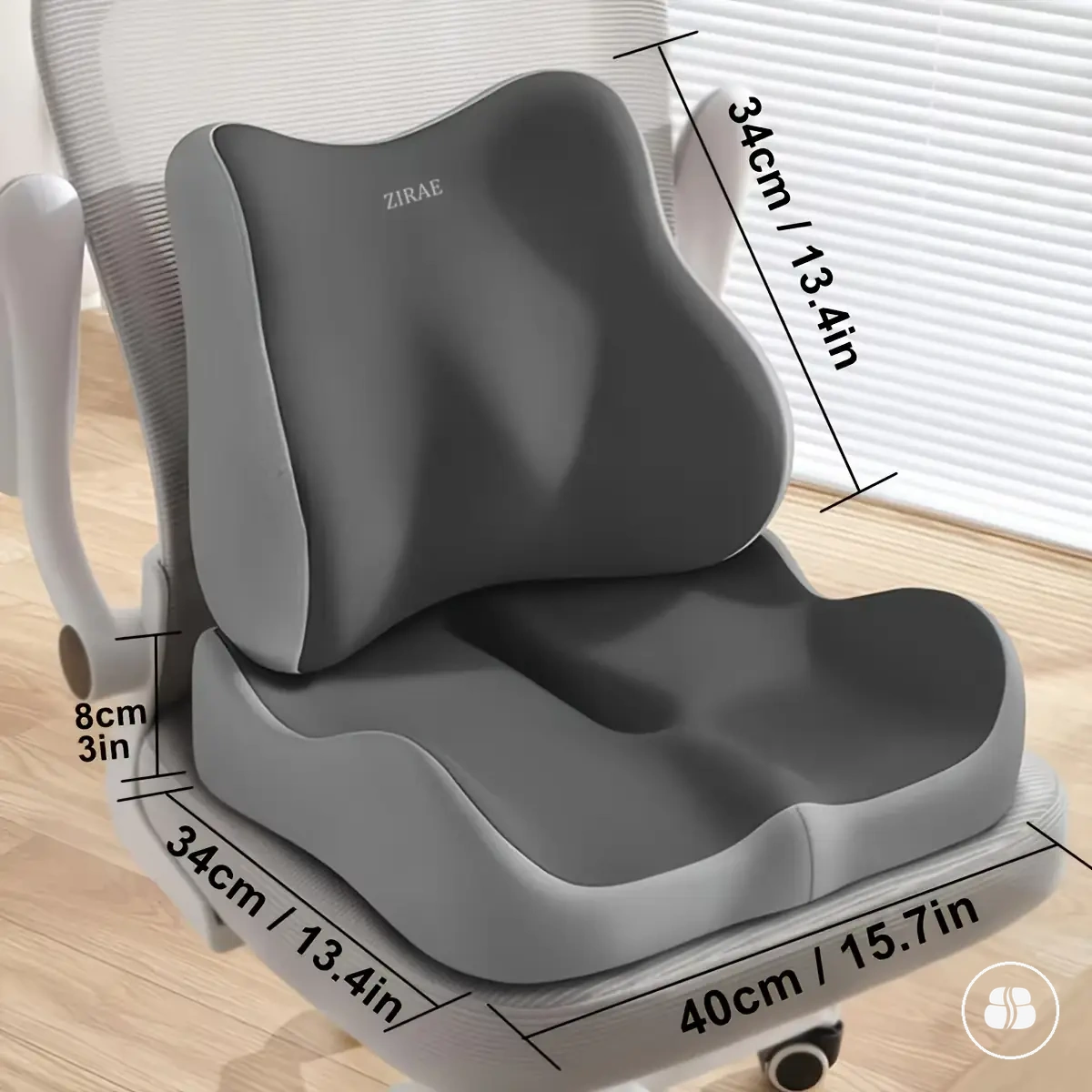
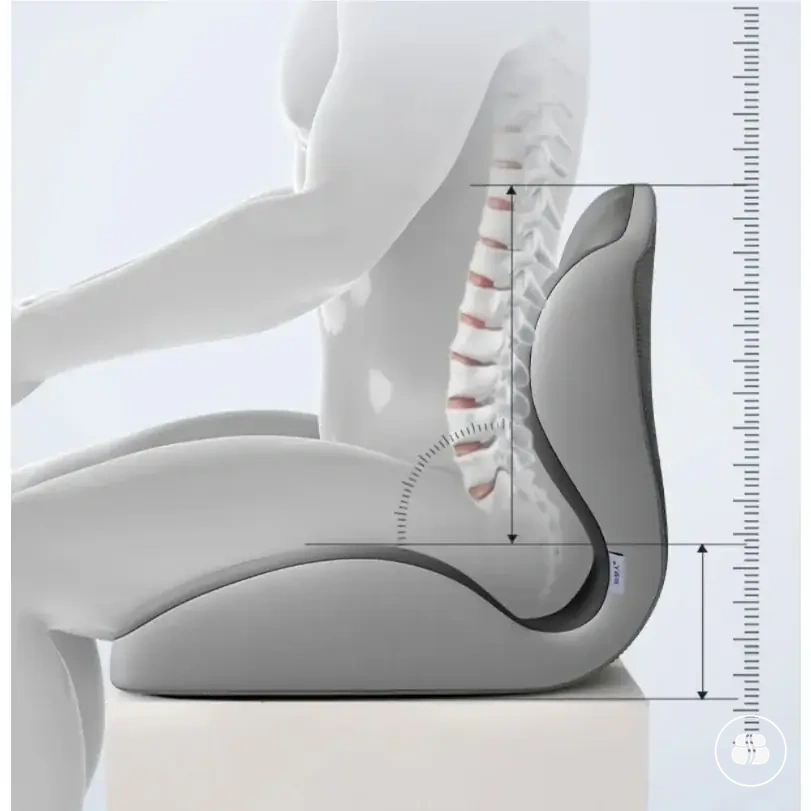
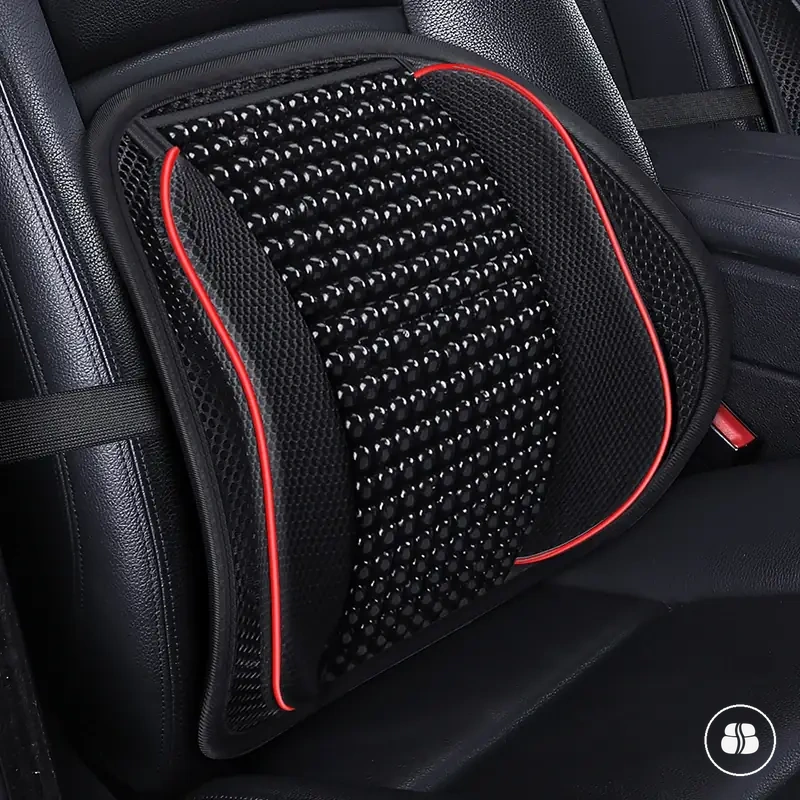
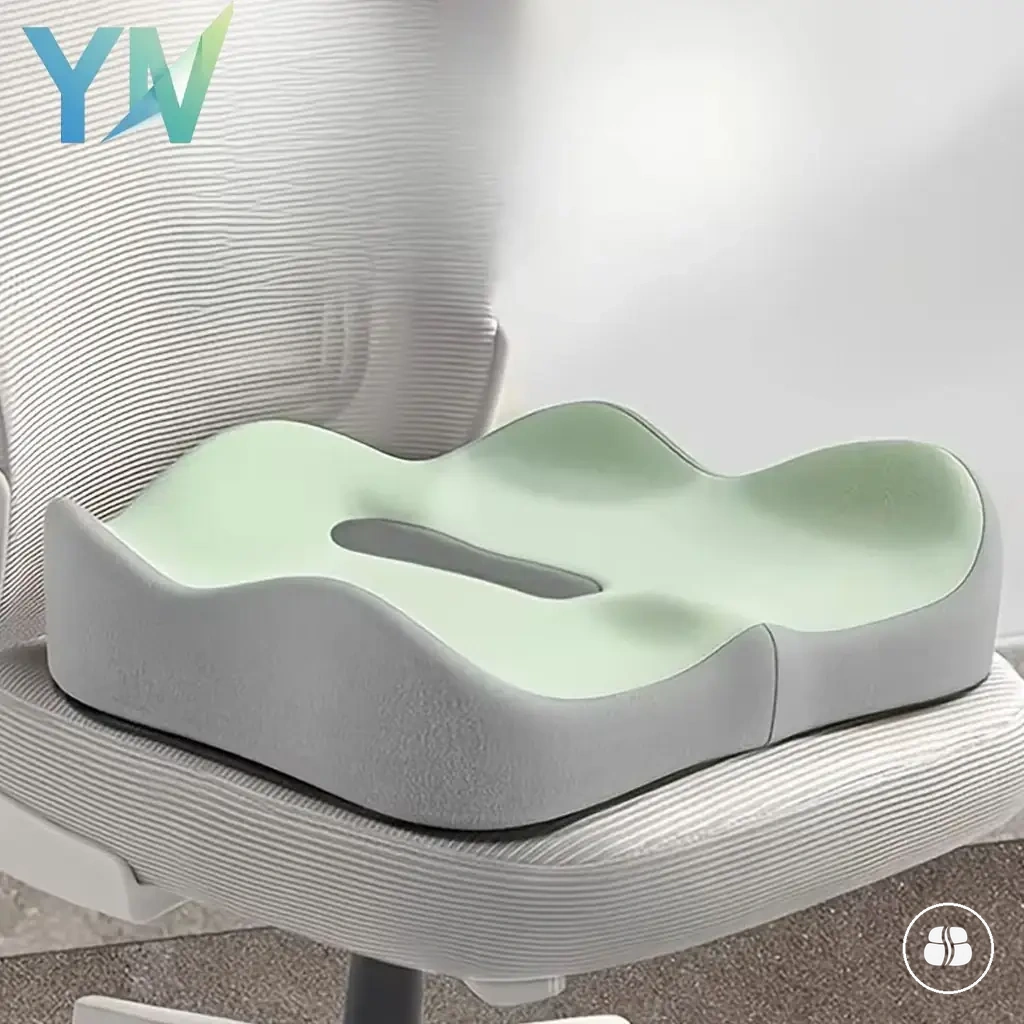
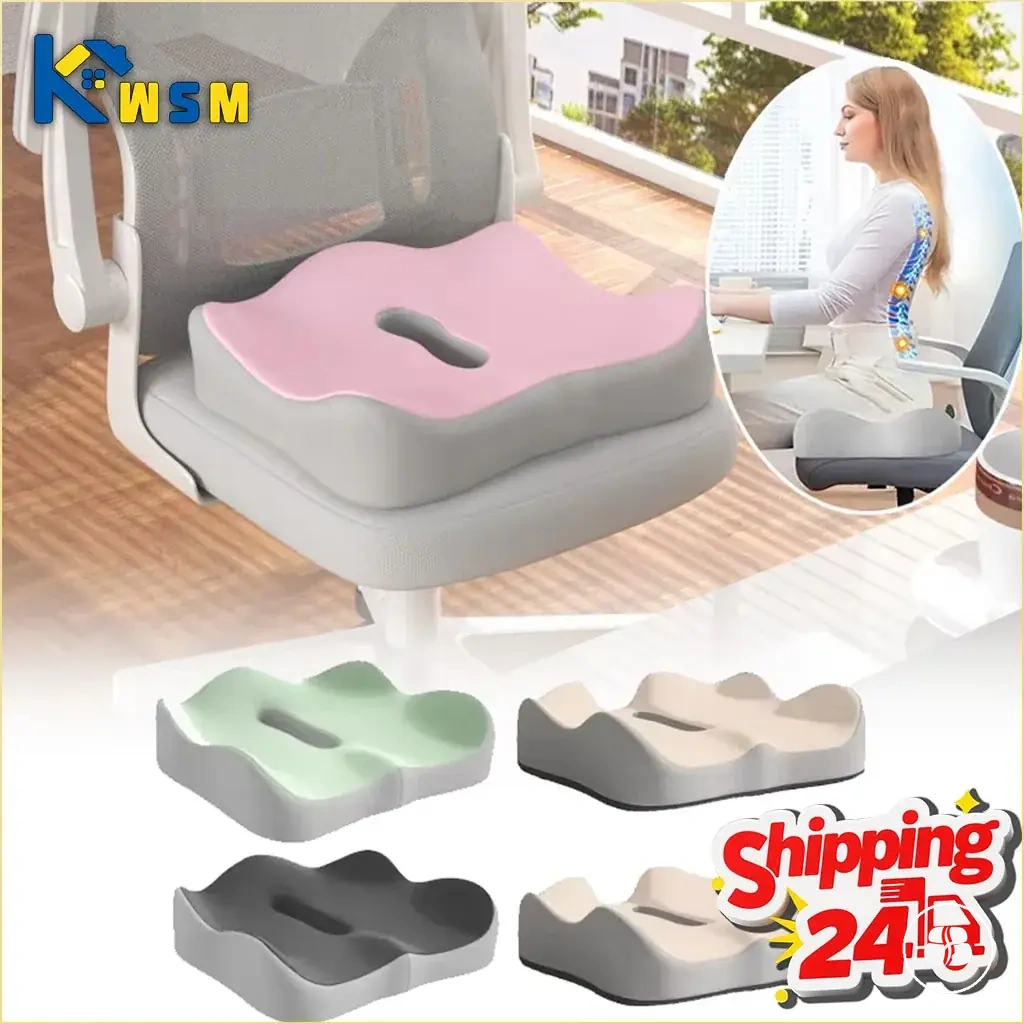
The products below are useful examples for comparing available options. Before buying, check that the compatibility criteria, key features, and product details match your needs.
Common setup conflicts between accessories, chairs, and desks
When slipping, pressure points, unstable contact, or reach strain occur, the likely cause is often the relationship between posture support accessories, chairs, and desks rather than a single component. Common setup conflicts can usually be traced to support stability, support placement, chair shape, or workstation conditions. These issues are often linked to fit, placement, or workstation mismatch.
Recurring setup conflicts may appear as slipping, pressure points, unstable contact, restricted movement, reach strain, or desk-height mismatch. A slipping accessory often requires a chair surface and support stability check, while pressure points may be associated with cushion height, support placement, or seated contact conditions. Reach strain may be connected to desk height or keyboard distance rather than the accessory itself. Because one symptom can have multiple sources, each setup issue should be checked individually.
| Conflict | Likely setup cause | Check | Possible adjustment |
|---|---|---|---|
| Slipping | Chair surface or support stability issue | Check whether the accessory moves during normal sitting | Review support placement or chair-contact conditions |
| Pressure points | Support placement or cushion height | Check where discomfort or concentrated pressure occurs | Adjust position or reassess contact conditions |
| Unstable contact | Fit conflict between the accessory and chair shape | Check whether contact changes during movement | Adjust placement or review chair compatibility |
| Restricted movement | Support format affects task movement | Check movement during normal desk activities | Modify setup conditions or reassess support format |
| Reach strain | Desk height or keyboard distance | Check reaching posture during work | Adjust workstation layout before changing the accessory |
| Desk-height mismatch | Workstation mismatch affecting seated position | Check whether posture changes during desk tasks | Review the relationship between the chair and desk |
If a symptom follows keyboard distance, desk height, or other workstation conditions, setup adjustment may be more relevant than changing the accessory. If the symptom remains linked to support instability, chair shape, or support contact after a workstation check, a different support format may be worth considering. These observations help identify likely setup relationships but do not determine the source of discomfort with certainty.
When the accessory fits but posture strain remains
When the accessory fits but posture strain remains, the likely cause is often a workstation mismatch rather than a support fit problem. Correct support fit does not resolve every workstation condition that may influence posture strain. The most common local cause pattern involves reach demands, screen position, desk height, task duration, or behavior patterns.
When the accessory fits but posture strain remains, use these checks before making another adjustment:
- Check whether repeated reach toward the keyboard, mouse, or work surface changes posture during normal tasks.
- Check whether screen height encourages forward positioning despite stable support fit.
- Check whether desk height affects arm position and contributes to a workstation mismatch.
- Check whether task duration, muscle fatigue, or behavior patterns reduce the effect of posture cues over time.
For example, support placement may remain correct while frequent forward reach preserves posture strain during computer work. If these checks point to a workstation condition rather than a fit problem, the next adjustment may be directed toward the workstation instead of the support format.
When the workstation prevents stable support placement
When the workstation prevents stable support placement, it is often due to slipping, tilting, compression, or clearance limits between the chair and desk. This can create posture strain even when support fit appears correct and usually indicates a workstation mismatch rather than an accessory issue. The most likely cause pattern is reduced stability caused by chair–desk interface constraints and uneven support contact. This pattern is consistent with the extracted section signals :contentReference[oaicite:0]{index=0}.
When the workstation prevents stable support placement, check the following conditions:
- Slipping caused by chair surface texture affecting support stability
- Tilting influenced by backrest shape or seat surface curvature
- Compression driven by cushion height or material response under load
- Clearance issues caused by armrest interference or restricted movement during work
Each check helps identify whether posture strain is linked to support fit, workstation mismatch, or placement limitations. If instability persists after these checks, the adjustment may involve repositioning the setup or considering a different support format depending on stability outcomes.
Safe daily use of posture support accessories at a desk
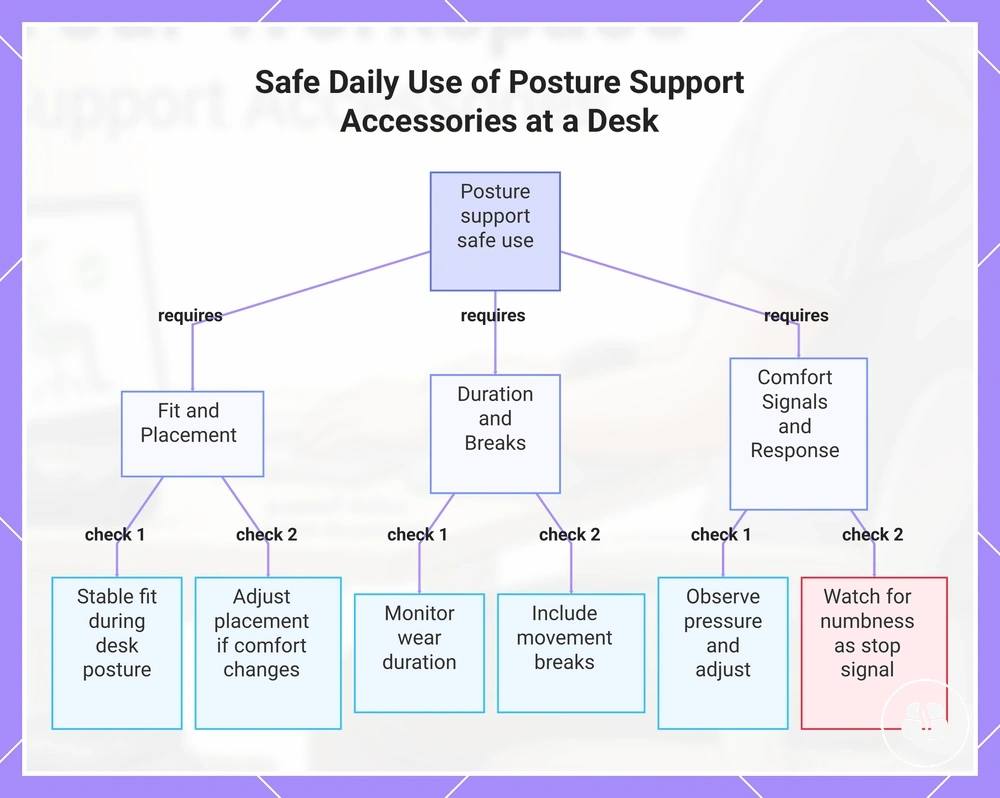
Safe daily use of posture support accessories at a desk depends on fit, wear duration, comfort signals, and task demands during desk work. These factors determine whether the support remains suitable throughout a daily desk routine and how the body responds over time, especially in relation to wear duration, pressure, numbness, discomfort, movement breaks, and adjustment tolerance.
During desk work, pressure or mild discomfort may appear if posture support accessories are used for extended periods without movement breaks or if the fit does not match the task demand. Numbness or increasing discomfort can signal that adjustment is needed in placement or duration rather than continuing unchanged use. Short movement breaks and small adjustments in position are often part of normal adjustment tolerance during daily use.
Safe daily use requires stopping or reducing use when signals persist or worsen instead of stabilizing over time. If pressure, numbness, or discomfort continues beyond normal adjustment tolerance, or if symptoms intensify during desk work, the setup should be reassessed rather than maintained in the same form. Persistent pain, worsening symptoms, or ongoing loss of comfort may indicate that continuing use in the same condition is not suitable under safe daily use boundaries.
For safe daily use of posture support accessories at a desk, follow this checklist:
- Check that fit remains stable during normal desk work posture
- Monitor wear duration to avoid prolonged uninterrupted use without breaks
- Observe pressure levels and adjust if discomfort increases
- Watch for numbness or reduced sensation as a stop-use signal
- Include movement breaks during longer desk sessions
- Adjust placement if comfort signals change during tasks
- Stop using if discomfort or symptoms persist or worsen over time
This chart outlines the key requirements and checklist items for safe daily use of posture support accessories during desk work.