
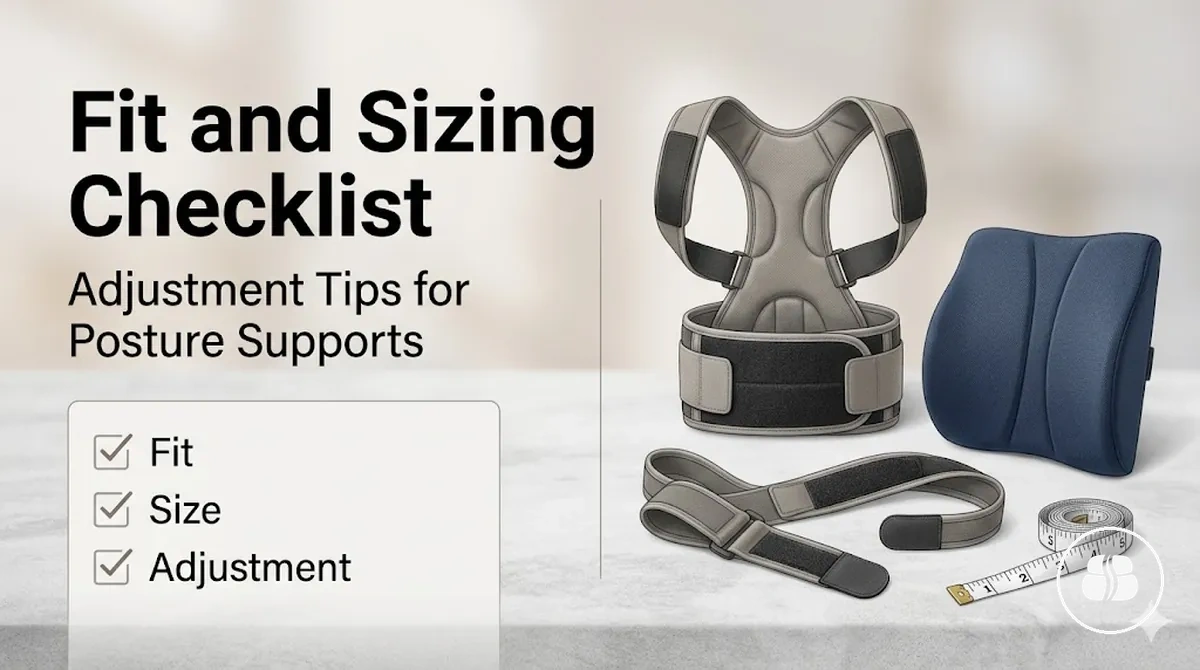
Posture support accessories fit and sizing checklist
Posture support accessories fit and sizing checklist refers to the decision framework used to evaluate whether posture support accessories align with body shape, adjustment range, and intended support behavior. Posture support accessories are a category of wearable or seat-adjacent tools that must be qualified by sizing logic rather than assumed compatibility, because fit outcomes typically vary based on individual proportions, accessory structure, and tension or positioning limits.
Fit evaluation in posture support accessories depends on how clearly the accessory can maintain support without introducing restriction or instability under normal movement conditions. This boundary between supportive contact and unwanted constraint is central to determining whether a given option is suitable for continued consideration. Posture support accessories hub provides the broader category context where these fit decisions connect to the overall accessory ecosystem and related evaluation paths.
This section frames fit and sizing as a structured decision layer rather than a fixed outcome, since posture support accessories may behave differently across body types, posture habits, and adjustment designs. The checklist perspective therefore organizes evaluation signals, ensuring that compatibility, comfort boundaries, and adjustment limits are assessed within a consistent interpretive structure.
Proper fit signals for posture support accessories
Proper fit signals for posture support accessories define the observable conditions that indicate whether posture support accessories align with body shape, adjustment range, and intended support behavior. Proper fit in this context is characterized by supportive contact that remains stable during normal movement, while avoiding restriction, excessive pressure, or instability that can occur when sizing or adjustment is not well aligned with the user’s body and setup.
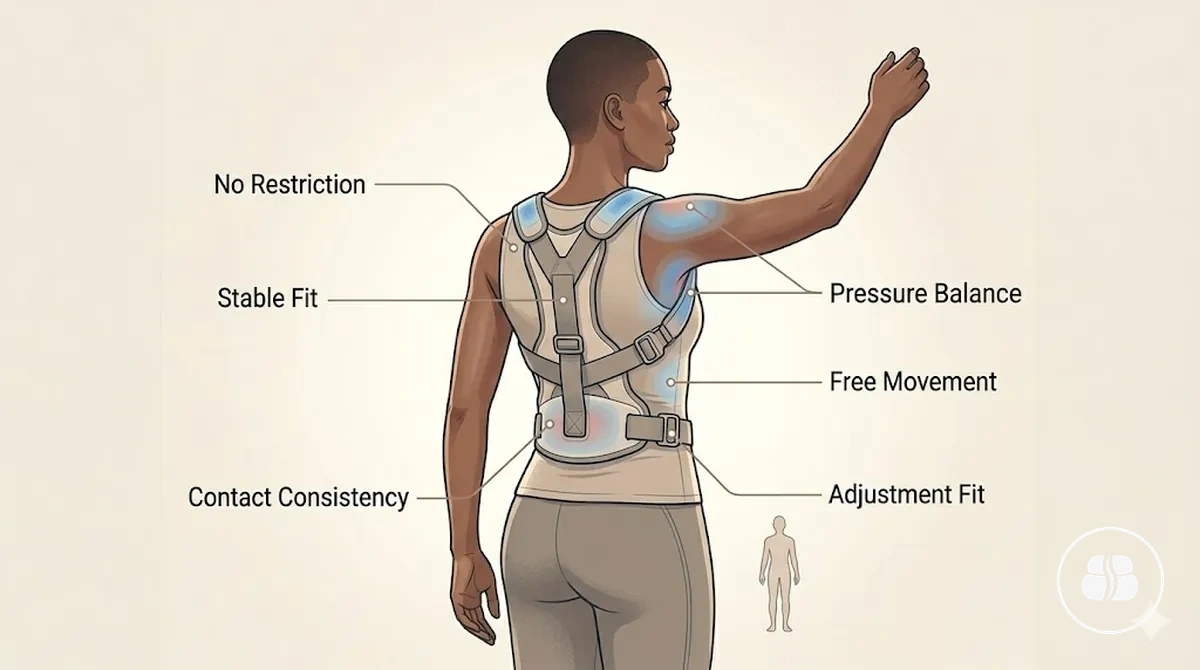
Proper fit signals are interpreted through how the accessory behaves during use rather than how it appears in a static position. Posture support accessories may feel acceptable at first placement but still require evaluation based on movement response, pressure distribution, and positional stability over time. A clear distinction is maintained between supportive engagement and uncomfortable restriction, since both can occur depending on adjustment precision and accessory type.
- Pressure balance: Support feels distributed without concentrated pressure points that increase discomfort during movement.
- Stability: The accessory remains in place without frequent shifting or readjustment during normal activity.
- Movement freedom: Arms, shoulders, or torso movement remains possible without noticeable restriction from the support structure.
- Adjustment awareness: Mild awareness of support may occur, but it should not develop into persistent discomfort or pain.
- Contact consistency: The accessory maintains consistent contact without gaps or slipping that reduce functional support.
Measurement and size-chart checks before choosing
Measurement and size-chart checks before choosing depend on comparing body measurement inputs with the corresponding size-chart fields to reduce sizing uncertainty. These checks help qualify likely fit outcomes, but they do not guarantee fit because posture support accessories may behave differently based on body shape, adjustment range, and design variation.
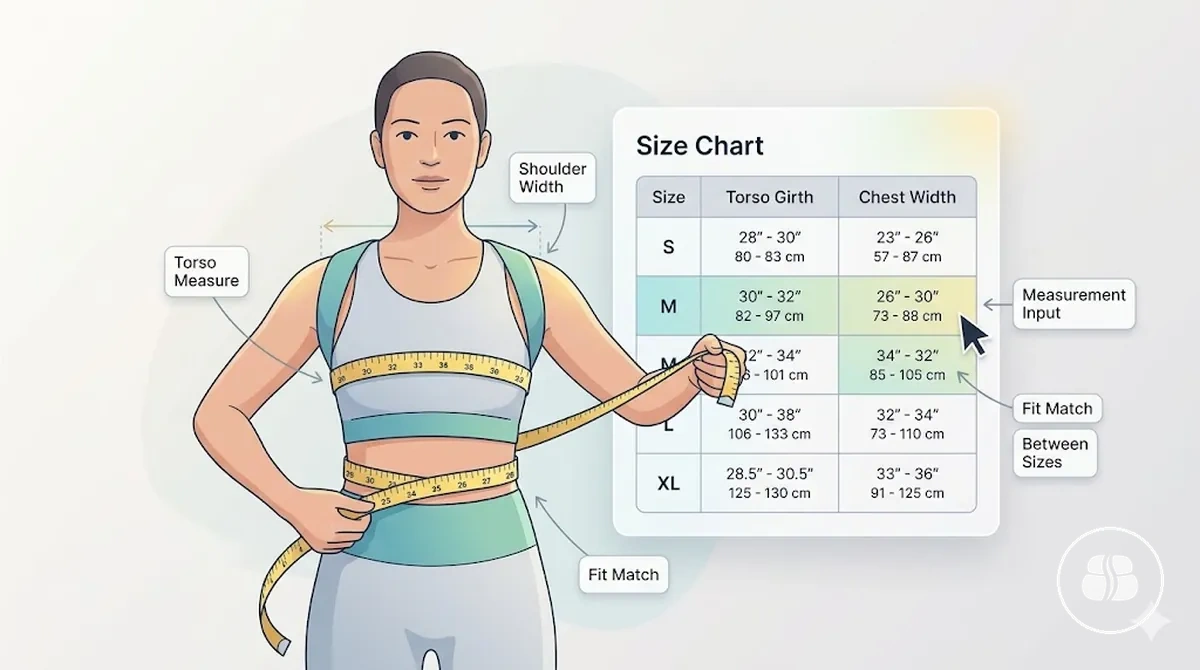
Measurement and size-chart interpretation focuses on mapping body dimensions to the listed sizing fields provided for posture support accessories. This mapping helps compare measured values against chart categories to assess likely compatibility, especially when users fall between sizes or when adjustable mechanisms introduce flexibility limits.
| Measurement input | Size-chart field | Fit implication | Condition note |
|---|---|---|---|
| Chest or torso measurement | Size range category | Indicates baseline compatibility range | May vary with adjustable strap systems |
| Shoulder width | Structural alignment range | Affects support positioning accuracy | More critical in rigid support designs |
| Back length | Coverage height range | Influences vertical support alignment | Partial adjustment may compensate in some designs |
| Between-size measurement | Upper or lower size threshold | Leads to flexible fit interpretation | Depends on adjustment and tension range |
Chest circumference and body measurement inputs
Chest circumference and body measurement inputs identify and qualify sizing decisions for brace-style posture support accessories. Chest circumference is commonly used as a primary reference for upper-body supports, while other body measurement inputs such as waistline, height, or weight may be required depending on the design and sizing system. In cases where measurements fall between ranges, fit interpretation may vary based on body shape differences such as broader shoulders or uneven torso proportions.
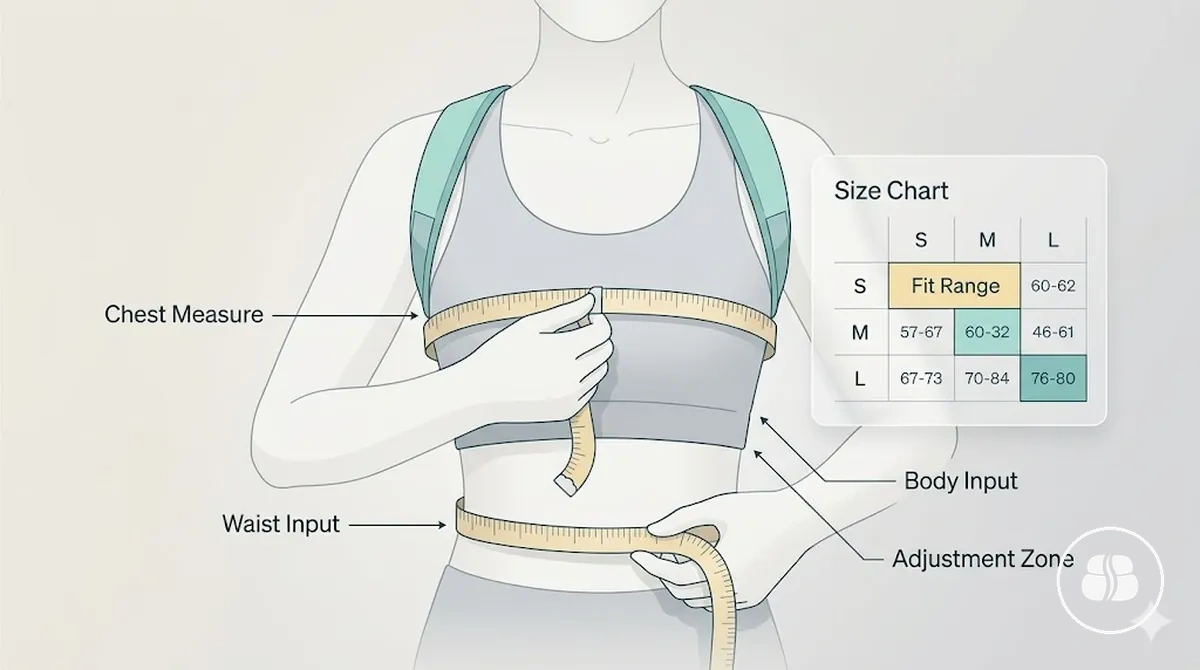
Chest measurement interpretation focuses on where the measuring tape is placed and how it relates to the support structure. For example, measuring around the fullest part of the chest under the armpits may align with brace sizing fields, but final sizing can still vary depending on adjustment range and how pressure is distributed across the torso.
- Chest circumference: Primary reference for upper-body brace sizing
- Waist input: Used when lower torso stability influences fit behavior
- Height reference: Helps estimate vertical coverage alignment
- Weight range: Sometimes used as a secondary sizing indicator depending on chart system
Brand size ranges and adjustable fit limits
Brand size ranges and adjustable fit limits determine how posture support accessories translate labeled sizes into actual wearable fit, where brand size ranges act as categorical sizing labels while adjustable fit limits define the physical range the product can expand or tighten. A sizing mismatch can still occur when a selected size falls within a brand range but exceeds the usable adjustment span, especially in cases involving broader shoulders, compressed torso geometry, or limited strap flexibility.
Brand size ranges should be understood as reference categories that group body measurements into simplified labels such as small or medium, while adjustable fit limits define how far the accessory can realistically adapt within that category. Even when a size label appears correct, the final fit may fail if the adjustment mechanism does not fully accommodate body distribution or if tension zones reach their limit before stable support is achieved.
| Aspect | Brand size range | Adjustable fit limit | Fit implication |
|---|---|---|---|
| Definition | Label-based sizing category | Physical adjustment capacity | Category match may not ensure usability |
| Function | Guides general selection | Controls real-world adaptation | Limits define actual wearing comfort |
| Failure condition | Incorrect category selection | Insufficient adjustment span | Fit may fail despite correct label |
Accessory type and support coverage differences
Accessory type and support coverage differences depend on how posture support accessories distribute contact across the body, where accessory type defines the structural form and support coverage determines how much area receives stabilization. These factors influence fit behavior because different structures apply force and contact in different zones, which can change comfort and alignment outcomes even when the overall purpose is similar.
Accessory type changes how support is delivered rather than simply how much support is provided. Brace-style supports concentrate alignment along specific torso zones, cushion-style supports spread pressure across wider surface areas, and posture pads apply localized adjustment points. Each type interacts differently with body position, seating context, and adjustment control, which means fit behavior may vary even under similar sizing assumptions.
| Accessory type | Support coverage | Fit behavior | Practical implication |
|---|---|---|---|
| Brace-style support | Localized torso zones | Structured contact with focused alignment | Fit depends on positioning accuracy and tension balance |
| Cushion-style support | Broader surface distribution | Diffused pressure response | Fit varies with seating posture and body weight distribution |
| Posture pad | Targeted elevation points | Subtle alignment influence | Effectiveness depends on placement stability and surface interaction |
Contact area across shoulder, back, and lumbar supports
Contact area across shoulder, back, and lumbar supports refers to the specific body zones where posture support accessories physically interact with the wearer, including shoulder contact points, upper back coverage, and lumbar (lower back) support zones. These areas determine how support force is distributed and how stable or uneven the fit may feel depending on body shape and sitting posture.
Shoulder contact areas guide strap positioning and upper-body alignment, but may feel uneven if pressure is not balanced across the back structure. Upper back contact influences overall stability, especially in brace-style designs where consistent surface engagement affects alignment. Lumbar contact defines lower support positioning, but its effect may vary depending on seating angle, movement, and how the accessory maintains alignment during use.
- Shoulder contact: Helps position upper support structure, but comfort may vary with strap tension and shoulder width.
- Upper back contact: Provides central stability and helps maintain alignment consistency.
- Lumbar contact: Influences lower support engagement and may shift with posture or seating changes.
Differences in contact distribution can change perceived balance, as concentrated support in one zone may feel stable for some users but uneven for others depending on body proportions and adjustment setup.
This chart shows the three main contact zones of posture support accessories and their specific functions and variability factors.
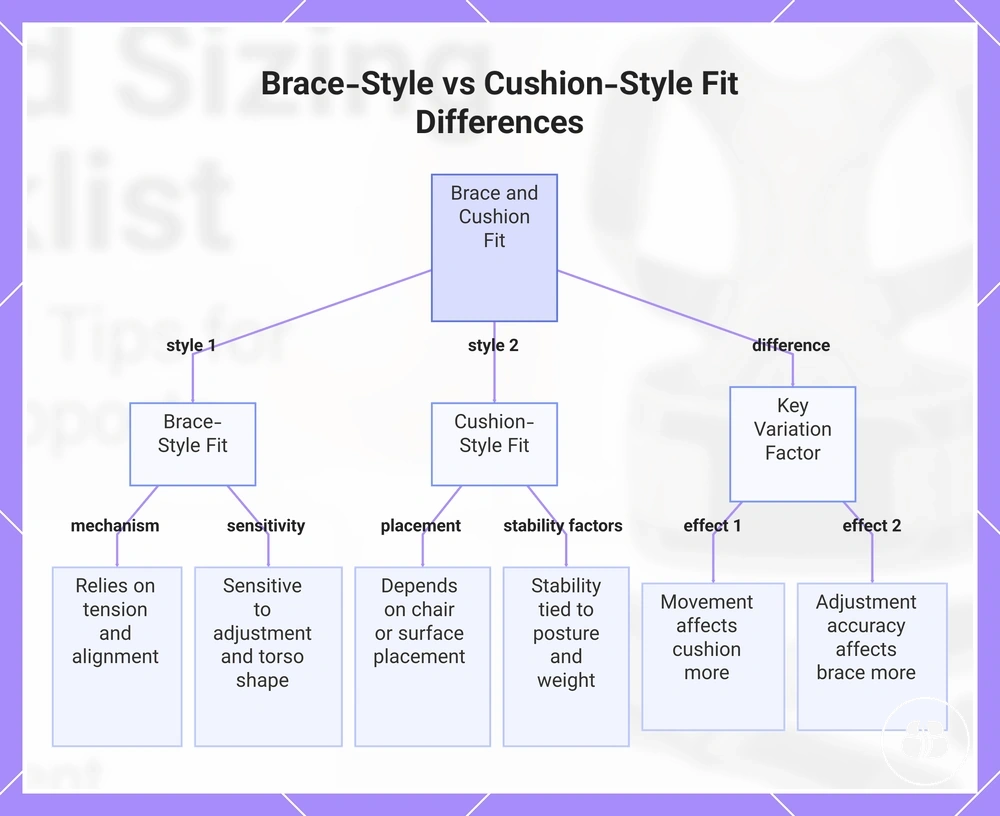
Fit changes between brace-style and cushion-style accessories
Fit changes between brace-style and cushion-style accessories depend on how each structure interacts with the body, where brace-style relies on wearable tension and cushion-style depends more on surface positioning and contact stability. These differences explain why the same user can experience a secure fit in one format and a shifting or less stable feel in another under different seating or movement conditions.
Brace-style accessories typically change fit through strap tension and direct alignment control, so fit quality is more sensitive to adjustment tightness, shoulder positioning, and torso shape. Cushion-style accessories change fit based on placement on a chair or surface, meaning stability often depends on seating posture, body weight distribution, and how consistently the user maintains position during use.
- Brace-style fit: Depends on wearable tension and alignment control across the torso.
- Cushion-style fit: Depends on surface positioning and stability against seating contact.
- Variation factor: Movement and posture changes affect cushion-style more, while adjustment accuracy affects brace-style more.
This chart compares how brace-style and cushion-style accessories change fit, highlighting their mechanisms, sensitivity factors, and key variation under movement versus adjustment.
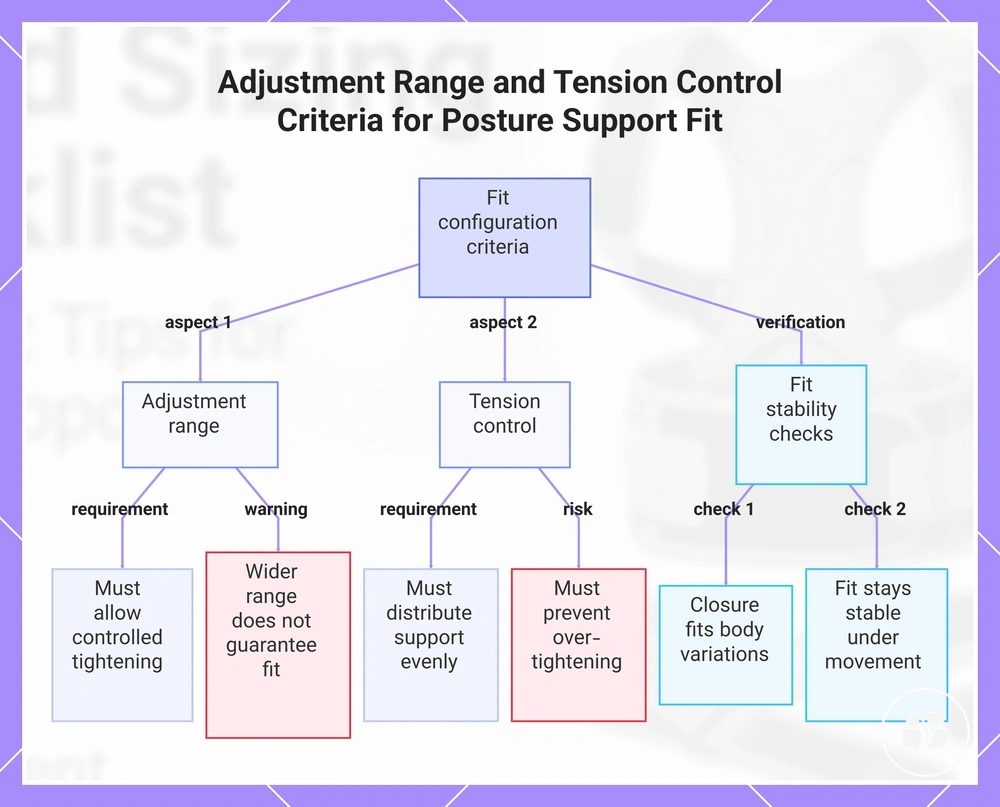
Adjustment range and tension control criteria
Adjustment range and tension control criteria depend on usable strap adjustability, closure limits, and how tension is distributed across the support structure. These criteria determine whether posture support accessories can be configured into a stable fit without creating excessive restriction or leaving areas under-supported.
Adjustment range defines how far the structure can expand or tighten across different body variations, while tension control evaluates how evenly that adjustment is maintained during use. A wider adjustment range may improve adaptability, but it does not ensure correct fit if tension becomes uneven or concentrated in specific contact zones.
The following criteria help evaluate whether adjustment and tension behavior remain within a usable fit boundary:
- Strap length flexibility: Should allow controlled tightening without forcing extreme positions that reduce stability or comfort balance.
- Closure range coverage: Must support secure fastening across different body variations without exceeding structural limits.
- Tension balance: Should distribute support evenly across shoulder and torso contact zones instead of concentrating force in one area.
- Fit stability under movement: Adjustment should remain consistent during posture shifts without frequent loosening or displacement.
- Over-tightening risk: Tension control should prevent excessive restriction when increasing support pressure for stability.
This chart shows the two main aspects of fit configuration—adjustment range and tension control—and the key checks used to verify a stable, comfortable fit.
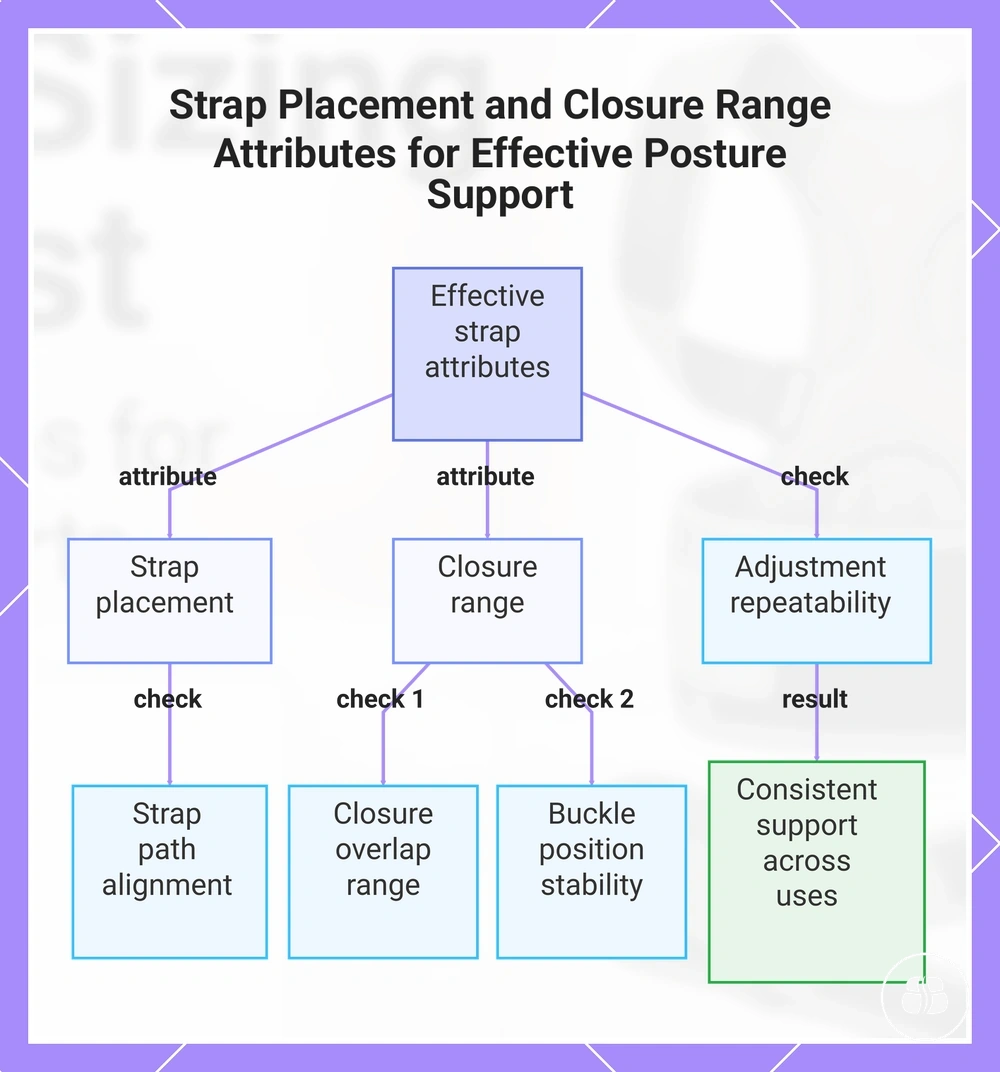
Strap placement and closure range
Strap placement and closure range refer to how posture support straps are positioned on the body and the usable fastening span available on the closure system. These attributes determine whether the support structure can maintain consistent alignment without shifting or requiring excessive tightening during use.
Strap placement identifies how the strap path runs across shoulder or torso zones, while closure range defines the available fastening positions such as hook, loop, or buckle overlap. Closure position affects repeatable adjustment because different fastening points change how tension is distributed across the support structure.
- Strap path alignment: Identifies whether straps sit evenly across intended support zones and maintain stable positioning.
- Closure overlap range: Verifies whether fastening points allow secure but controlled adjustment without exceeding design limits.
- Buckle position stability: Qualifies whether closure points remain fixed during normal movement without shifting.
- Adjustment repeatability: Ensures the same closure position produces consistent support across repeated use.
This chart shows the two main attributes of posture support straps — strap placement and closure range — and the key checks to verify their effectiveness.
Snug support without restricted movement
Snug support without restricted movement depends on how snug tension in posture support accessories aligns with natural body motion while maintaining mobility in shoulders, arms, and torso. Snug support and restricted movement are evaluated together to qualify whether stability is achieved without limiting normal functional movement such as reaching, sitting adjustments, or posture shifts.
Snug support indicates close-fitting tension that stabilizes posture, while restricted movement occurs when that tension limits basic mobility. The balance between the two varies by accessory design, strap configuration, and how the closure system distributes pressure across the body.
- Shoulder mobility: Snug support should allow natural arm elevation without limiting range of motion.
- Breathing comfort: Support should remain stable without creating restrictive pressure on the upper torso.
- Arm reach: Movement should stay functional without tightening effects increasing during extension.
- Posture flexibility: The structure should adapt to small posture changes without locking movement patterns.
Fit checklist before partner price comparison
Fit checklist before partner price comparison refers to the set of verification conditions used to confirm whether posture support options are ready for external comparison based on stable fit behavior, sizing clarity, and adjustment consistency. The fit checklist and ready-to-compare options are assessed before moving into any partner pricing stage.
The fit checklist and ready-to-compare options are separated by identifying unresolved sizing, unclear adjustment range, or inconsistent comfort response. Options that fail basic fit stability checks are typically excluded to avoid comparing items that may not meet baseline usability conditions across different body contexts.
A structured checklist approach helps verify whether an option is stable enough for comparison without mixing uncertain-fit items with ready-fit selections. Each criterion focuses on condition-based validation rather than preference or price influence.
Fit readiness should be evaluated using structured guidance such as How to choose posture support accessories which helps qualify selection conditions before external comparison.
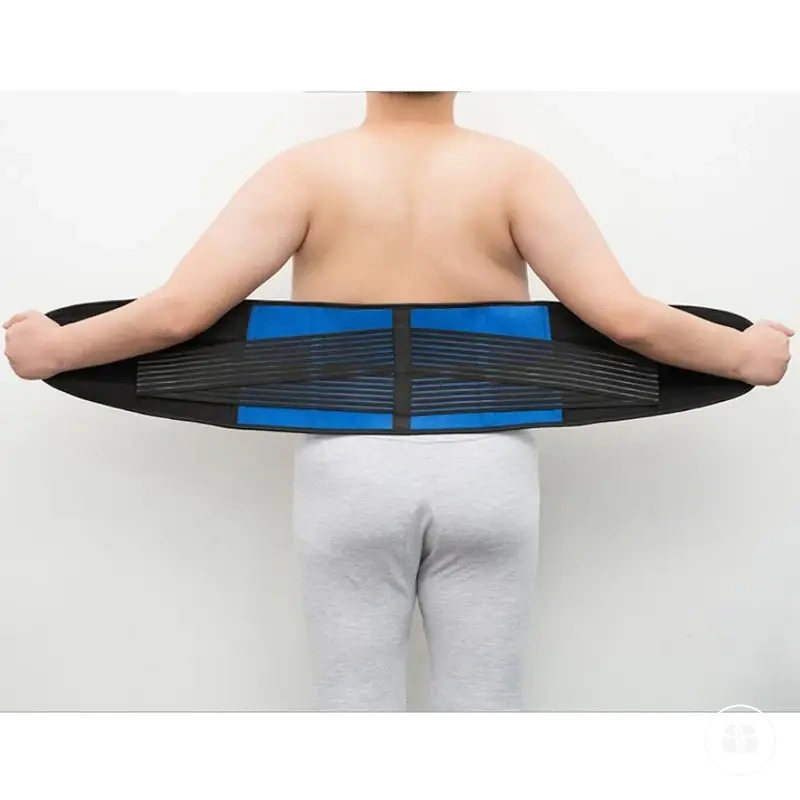
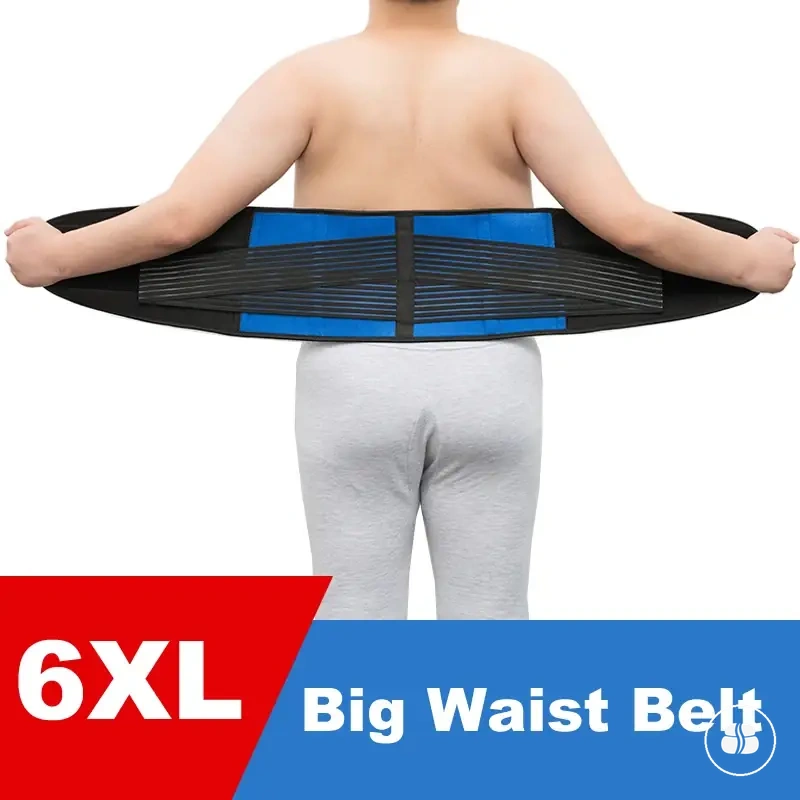
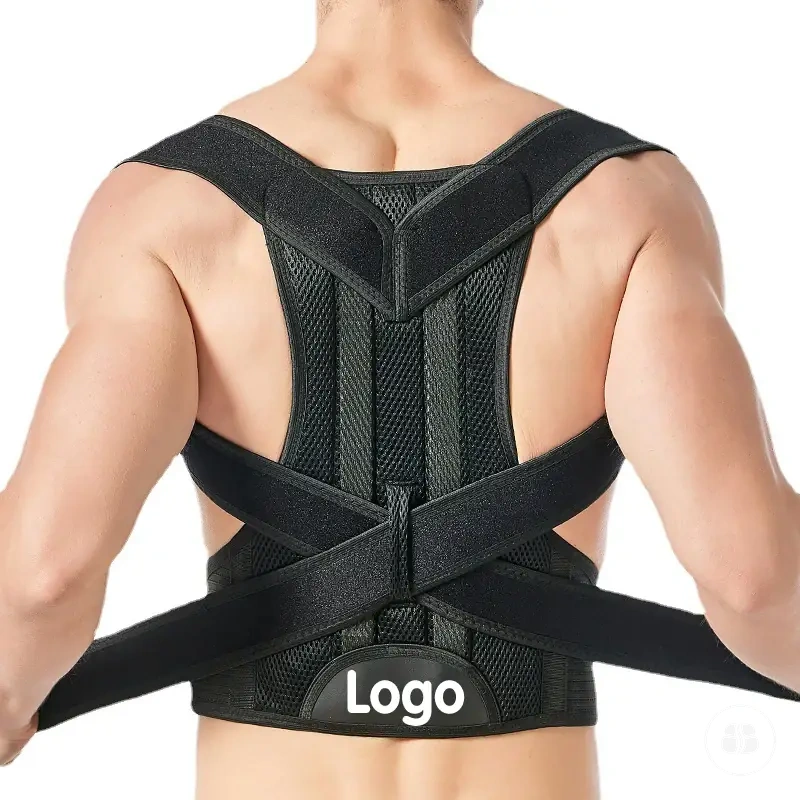
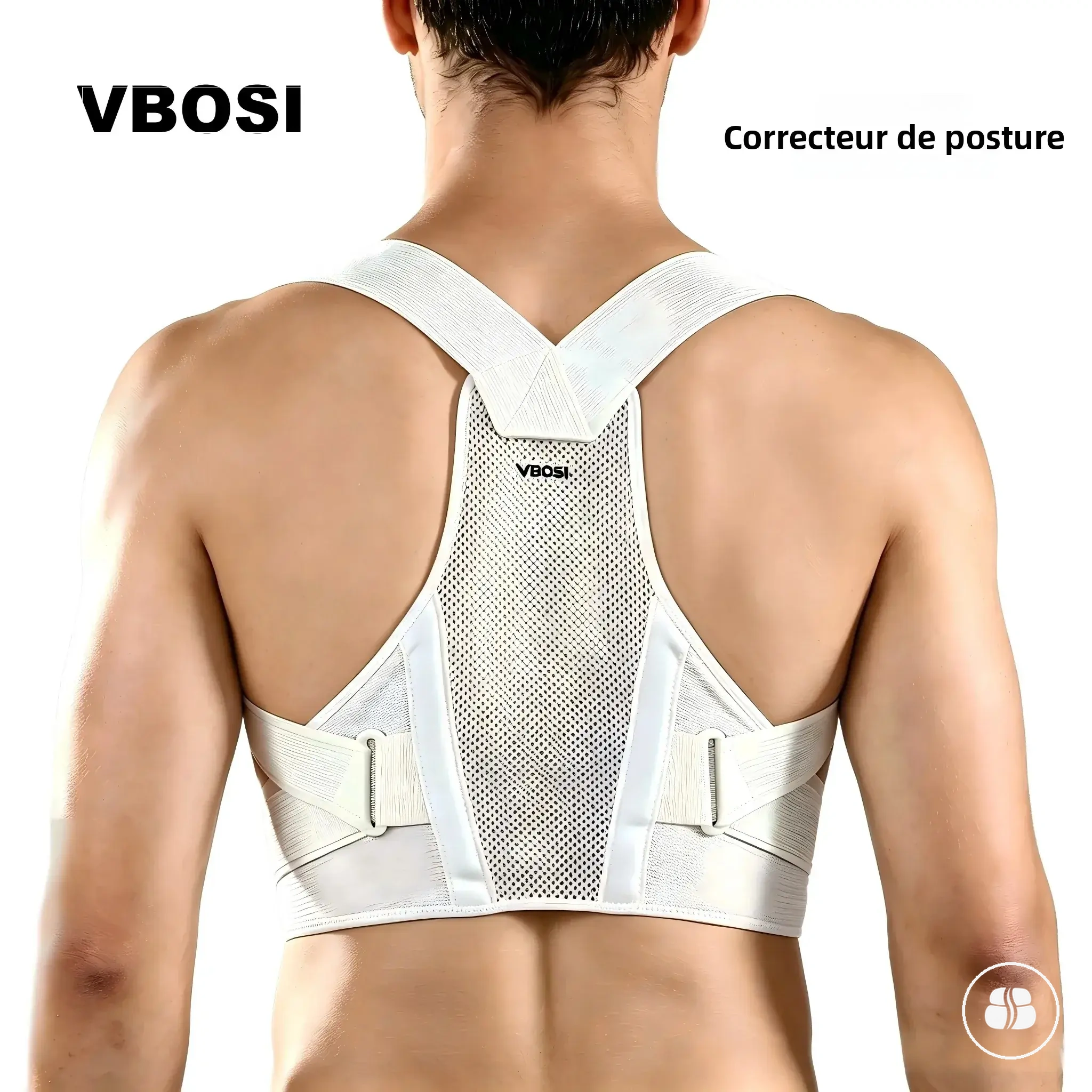
The products below are useful examples for comparing available options. Before buying, check that the compatibility criteria, key features, and product details match your needs.
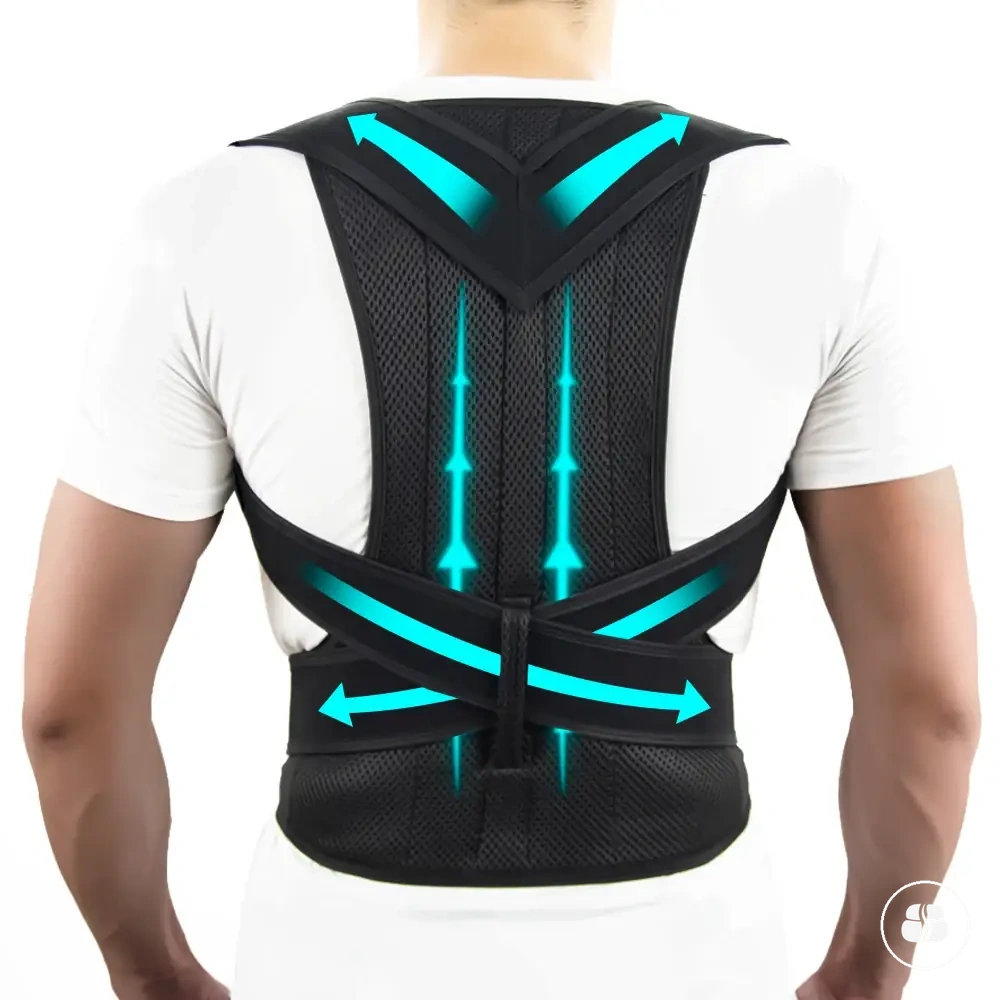
- Size clarity: Verify that sizing information is consistent and not conflicting across ranges.
- Adjustment stability: Confirm that strap and closure settings allow repeatable positioning without shifting.
- Comfort consistency: Qualify whether support remains stable without uneven pressure or restriction.
- Return-risk signals: Separate unclear fit cases that may affect post-comparison satisfaction reliability.
This chart outlines the key verification criteria and decision outcomes used to determine whether posture support options are fit-ready for external price comparison.
Too tight, too loose, or uncomfortable fit signals
Too tight, too loose, or uncomfortable fit signals are diagnostic indicators that posture support accessories are not aligning properly with snug support expectations and are instead producing restriction, instability, or uneven pressure. These fit signals help qualify whether the issue comes from excessive tension, insufficient adjustment, or inconsistent contact across support zones.
Too tight fit signals usually appear when compression limits shoulder or torso movement, creates localized pressure, or reduces breathing comfort during normal posture. Too loose fit signals typically show as shifting straps, unstable positioning, or weak support engagement during movement. Uncomfortable fit signals often occur when sizing appears correct but pressure distribution is uneven or changes during activity.
| Fit signal | Likely cause | Decision guidance |
|---|---|---|
| Too tight | Excess tension or undersized fit range | Reduce tension or reassess sizing compatibility if restriction continues |
| Too loose | Insufficient adjustment or oversized selection | Increase adjustment engagement or evaluate smaller size option |
| Uncomfortable fit | Uneven pressure distribution or posture mismatch | Recheck strap placement and balance across contact zones |
Pressure, breathing, and circulation warning signs
Pressure, breathing, and circulation warning signs indicate that snug support in posture accessories is exceeding safe comfort balance and beginning to restrict normal body function. These signals warn that pressure may be too concentrated or uneven, affecting breathing comfort or circulation in sensitive contact zones.
Pressure-related warning signs include persistent tightness that does not improve after minor adjustment, breathing difficulty during normal posture, numbness or tingling sensations, or visible skin irritation. These conditions help qualify when the fit should be adjusted or the accessory removed to restore safe comfort conditions.
- Pressure buildup: Localized force that remains uncomfortable even after minor repositioning.
- Breathing restriction: Reduced comfort during normal breathing due to excessive tightness.
- Numbness or tingling: Sensory changes that may indicate excessive compression on nerves or circulation zones.
- Skin response changes: Redness or irritation suggesting uneven pressure distribution.
Slipping, gapping, and weak support signals
Slipping, gapping, and weak support signals indicate unstable fit behavior where posture support accessories fail to maintain consistent contact with the body or seating surface. These signals help diagnose whether instability is driven by sizing mismatch, incorrect positioning, or insufficient structural engagement across support zones.
Slipping typically occurs when the accessory shifts during movement, which may point to loose adjustment or weak anchoring. Gapping appears when visible space forms between the support and the body, often linked to incomplete contact or misaligned placement. Weak support signals occur when stability feels reduced even without obvious movement, usually indicating uneven load distribution or context-dependent fit mismatch.
- Slipping: Movement during use that suggests insufficient grip or tension control.
- Gapping: Visible separation between support and body indicating incomplete contact.
- Weak support: Reduced stability during posture changes, often linked to uneven distribution.
Fit boundaries for wear time, safe use, and chair setup
Fit boundaries for wear time, safe use, and chair setup depend on how posture support accessories maintain stable contact across different duration, comfort sensitivity, and seating configurations, where each condition can change how fit is interpreted in real use contexts.
These boundaries separate fit interpretation from adjacent context areas such as office seating setups. Posture support accessories for office chairs should be considered when chair structure or positioning changes alignment behavior during use.
Wear duration, safety comfort, and chair setup do not define sizing alone but influence how fit stability is experienced across different environments and posture shifts.
The products below are useful examples for comparing available options. Before buying, check that the compatibility criteria, key features, and product details match your needs.
| Boundary factor | Fit relevance | Context consideration |
|---|---|---|
| Wear time | Affects sustained comfort and stability | May change fit perception depending on duration and movement |
| Safe use | Relates to pressure tolerance and comfort response | Varies by sensitivity and support distribution |
| Chair setup | Influences alignment and contact consistency | Depends on seating design and posture positioning |